


Update on the collaborative planting trials between Royal Botanic Gardens Kew, the Sustainability Institute and its Local WILD Food Hub, and Grootbos Private Nature Reserve and its Foundation.
The local indigenous edible plants of the Greater Cape Floristic Region offer a promising path toward sustainable food security; some contain up to five times more vitamins and minerals than introduced species while requiring fewer inputs and demonstrating greater climate resilience.
Recognising this potential, the Sustainability Institute’s Local WILD Food Hub, Royal Botanic Gardens Kew and Grootbos Private Nature Reserve launched collaborative field trials in June 2025 to systematically explore the cultivation potential of six of these wild, edible plants. Once the staple food source for South Africa’s hunter gatherers many of them have been “forgotten” by our current way of food production and access, and are now threatened by urbanisation.
Led by Loubie Rusch of the SI’s Local Wild Food Hub and Dr Nicola Kühn of Kew Gardens these trials are testing how water availability and planting density influence yield, nutrition, and climate-resilience traits across six species: dune spinach, sea pumpkin, sandkool, veldkool, ice plant and sea parsley.


Five months into the trials, the teams have navigated both expected challenges and valuable learning opportunities. Porcupines at Grootbos found the sea pumpkin utterly irresistible and their enthusiasm for the plant required the installation of protective enclosures. The guinea fowl were having a literal field day as they responded to the soil disturbance from the planting of fields next door to the Grootbos farm. These unintended ‘visitors’ highlight the realities of cultivating these plants in biodiverse landscapes.
The ice plant initially struggled to establish from seed at both sites but is now beginning to take hold, and sea parsley has shown surprisingly better performance in non-irrigated conditions at Grootbos which could indicate encouraging data for climate resilience.
Despite these challenges, progress has been made: the team has developed harvesting protocols for five of the six species, establishing guidelines for timing, technique, and just how much to harvest. These protocols are living documents that will continue to evolve as lessons emerge from this first trial round.
It has also been interesting to note how the tech used to support the data capturing has had its fair share of challenges. The SI’s IT lead, Cameron Gordon, has been instrumental in managing and overcoming each of them as they have emerged. The solution is a new hub that will fix communication between the weather station and soil sensors, and this is on its way to the teams on site.

Ensuring future continuity
The partnership is currently seeking additional funding to extend the trials into next year, ensuring continuity of this vital research and the opportunity to build on early findings.
As the planting trial’s funding draws to this calendar year’s end it is vital that new funders are found to support further nutritional analysis of the indigenous edibles and how they can provide improved nutrition and contribute to long term food security based on the changing climate of the region.
Having a dedicated human resource to manage the project and create the stories needed to share its wonders and findings is very much needed. As a result, the team are looking for grant funding for a longer-term investment into research of the plants’ nutritional values and the human and ecological resources that are being presented.
This research responds to urgent global needs, with over 768 million people affected by malnutrition worldwide and Sub-Saharan Africa experiencing the highest prevalence at 21.8% of its population.
Impact on the ground
The trials follow a three-pronged approach of KNOW, GROW, USE and build upon existing work including two practical guides by Loubie Rusch and preliminary nutritional research showing strong potential for these plants to meet dietary needs.
Beyond their nutritional benefits, these indigenous foods offer additional advantages: they can thrive in poor soils with limited irrigation, reduce climate footprints through local sourcing, and help preserve cultural heritage and indigenous knowledge.
Both the Sustainability Institute’s Green Cafe and Grootbos Reserve’s kitchens already serve these plants, with the trials aimed at understanding quantities needed to produce menus at scale. The flavour and versatile uses of the indigenous edibles is remarkable and unforgettable after you have tried them. Just ask the porcupines.
For more information about the field trials, you can contact
Dr Nicola Kühn, Research Fellow, RBG Kew email n.kuhn@kew.org
Loubie Rusch – Local WildFood Hub localwild@sustainabilityinstitute.net | www.sustainabilityinstitute.net
Grootbos Foundation: Conservation Director – Sean Privet https://grootbosfoundation.org/
More about the project:
The field trials are led by Dr Nicola Kühn of Kew Gardens and Loubie Rusch at the Local Wild Food Hub (LWFH) which is part of the Sustainability Institute. Under their expert guidance, these trials are contributing to the LWFH vision of normalising the use of local indigenous foods (of the GCFR) to benefit people and their local food environments.
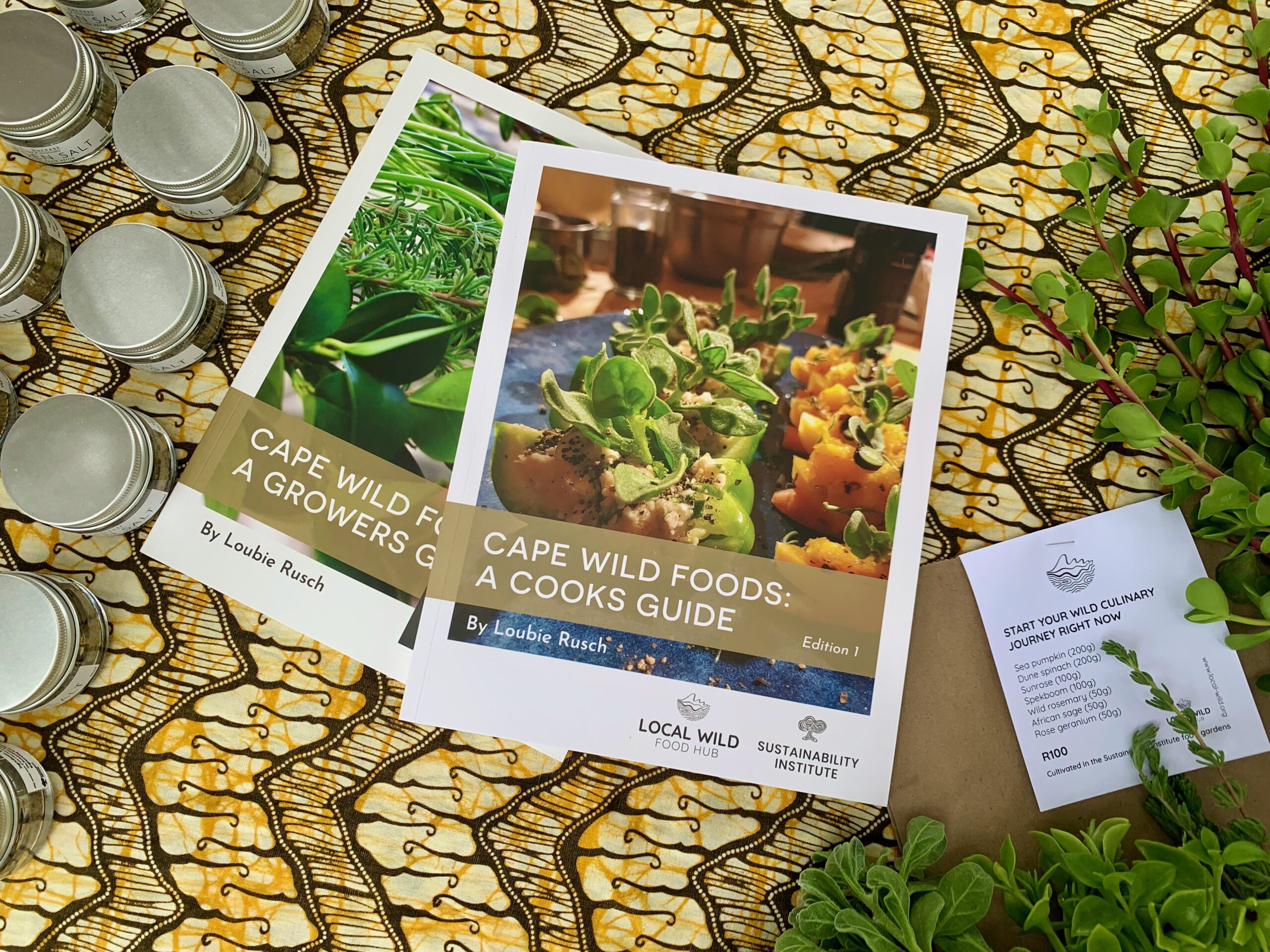
The knowledge already gained has been artfully combined in two books, Cape Wild Foods: A Grower’s Guide and Cape Wild Foods: A Cook’s Guide written by Loubie Rusch who has been exploring the forgotten and underutilised local indigenous foods of the Cape since 2010.
The Cook’s Guide is the sequel and culinary compendium to the Growers guide and shows 22 plants aimed at home and professional cooks, bringing them ingredient information, menu and cooking ideas and recipes to follow about local foods they may be intrigued by, but are not sure how to use in cooking.