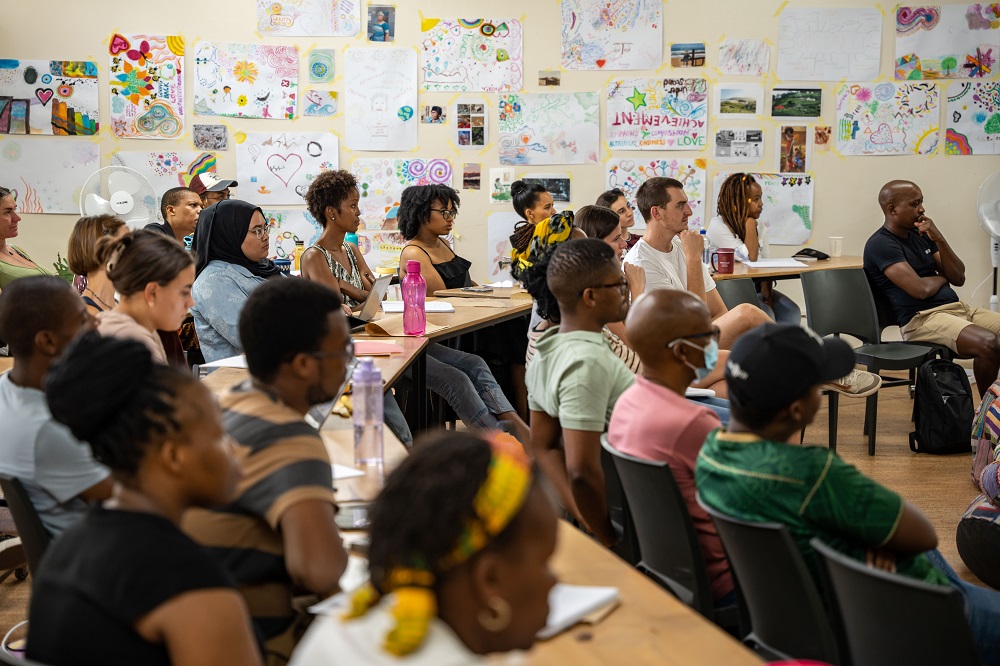
Tom Renault spent six years in South Africa, completing his undergraduate and postgraduate studies at Stellenbosch University. During this time, he worked at the Sustainability Institute, where the Postgraduate Diploma was hosted.
During 2023 he and co-author, Reinhold Mangundu, wrote a chapter for the book Pedagogy of the Anthropocene Epoch for a Great Transition: A Novel Approach of Higher Education. The chapter is called Learning to engage with complexity through the transformative learning approach of the Sustainability Institute in South Africa.
This chapter unfolds the value added by the Sustainability Institute as a praxis hub. It unpacks the pedagogical philosophy that embraces complexity and the need for teachings to be rooted in their geographical environment.
The South African context combines historical traumas of Apartheid, current record-high inequalities and an environmental crisis unfolding. It thus urgently calls for a just transition. The chapter further argues that in light of such socio-ecological crisis, it is essential to value learners’ emotions and to build resilient communities within the learning process that ultimately allow for transformative learning. (To access or purchase this book, please visit the Springer website.)
We spoke to Tom to find out more about why he chose to include the SI, and gather a bit more reflections on a personal note. He shared with us around the following topics, with some wonderful, relevant advice we all can apply:
- The ‘Great Transition’ and education:
“Universities play a fundamental role in shaping not only skilled professionals, but also critical citizens capable of questioning dominant systems and imagining alternatives.”
- Defining ‘Wicked Problems’:
“Wicked problems are complex, evolving, and interconnected. Every intervention can produce unintended consequences elsewhere within the system.”
- The ‘Praxis Hub’ Concept:
“Praxis-based learning allows sustainability to become something lived and experienced rather than simply studied – the learning process becomes far more authentic and grounded.”
- Learning from South Africa:
“There is little meaning in protecting ecosystems or reducing carbon emissions if we fail to address the structural systems that continue to produce exclusion, exploitation, and inequality.”
- A ‘Just Transition’:
“A just transition seeks to ensure that the move toward more sustainable societies does not reproduce or deepen existing inequalities.”
- Managing ‘Eco-anxiety’:
“Artistic and reflective practices open forms of knowledge that go beyond purely rational analysis.”
- The power of empathy:
“Many forms of suffering remain invisible. Sustainability requires expanding our moral imagination toward non-human life, ecosystems, and future generations.”
- The ritual of Ilima:
“Sustainability is not only an intellectual concept but also a lived practice rooted in reciprocity, care, and interdependence.”
- Child-centered design:
“Hearing children laugh, play, and learn every day acts as a constant reminder that sustainability work is ultimately about future generations.”
- The future of universities:
“The challenges of the Anthropocene require a much greater openness to uncertainty, dialogue, and multiple ways of knowing.”
Click here to read his reflections.