


If we could make the invisible impacts of our choices and behaviours visible, what would that change within us, and in our communities and the environment?
We asked this question by imagining we had to wear the waste that we generated every month, accessorising our clothing. Imagine what we would look like after a year, after a lifetime. What would that do for our understanding of waste?
When we throw things ‘away’, it does not go to a place disconnected from us. It ends up in a landfill, a river, an open field, a forest or wetland. This has serious consequences, such as water pollution, biodiversity trashing and grazing animals and sea life being exposed to more and more plastic.
The statistics aren’t encouraging
- South Africa generates more than 50 million tonnes of general waste a year, with only about a third being recycled. Around 1 in 3 people (more than 5 million households) lack access to regular waste collection, and open burning of waste is common practice.*
- Much of the actual recycling work is done informally: waste reclaimers recover 80–90% of plastic and packaging in the country, saving municipalities up to R750 million a year in landfill costs. They carry the health hazards and social stigma despite doing hard, essential work.*
Although recycling is a great way to manage packaging waste, we need to look at the bigger picture that includes purchasing behaviours, waste management systems, economic systems and people’s attitude towards waste, to find more appropriate solutions. For example, not all items placed in recycling bins end up being recycled. It’s estimated that only 9% of plastic worldwide is recycled*, so we need to explore more systemic issues surrounding waste if we want to make a long-term impact.
The Lynedoch Eco-Village is an example of Stellenbosch municipality residents that have taken initiative to become responsible for managing their own waste. Every person living in the Village, working at the Sustainability Institute or school, tenants and students all are encouraged to sort their waste by using the marked dustbins on site. Over the years the most difficult thing has been to get waste recycling right because it requires behavioural change from people. This remains work in progress.
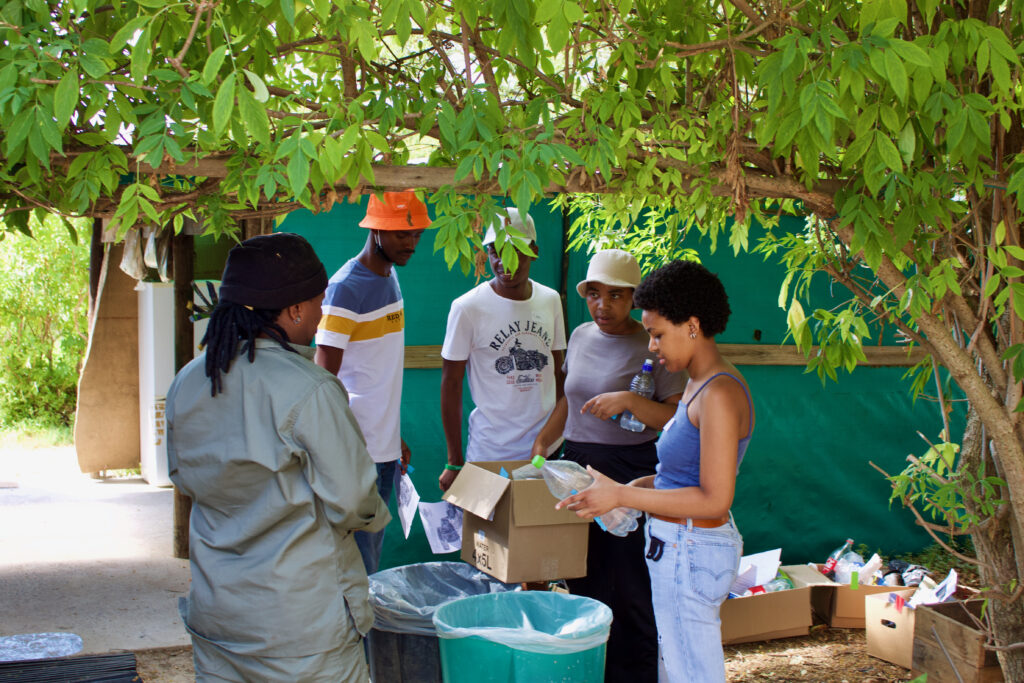
Sustainability Institute waste centre
Circular systems and product design
In our future, ideal world, products would be designed to have no waste, but this requires a systemic shift in our approach to resource usage and management. If all the invisible resources and processes were made visible to the consumer, how would that change consumer behaviour? Imagine all labels had to state the water, biodiversity and pollution impacts?
Waste is an interesting concept because it only exists in relation to what we know and see. If you think about production and consumption in a linear way (i.e. a straight line with a clear beginning and an end), then waste is normally defined as a material or substance that serves a specific purpose, after which it becomes no longer useful.
For example, a piece of plastic is formed into the shape of a bag to hold vegetables. Once we open the bag and take the vegetables out to prepare for a meal, the plastic bag is no longer of use to us so we throw it away.
Imagine if the plastic was either:
- Not created in the first place (reduced) as it is considered an unnecessary material
- Recycled after being used and transformed into something else to be used at a later stage
- Or bought once and then reused many times, which reduces the need for more of the same material to be made again
If we thought about the lifecycle of materials or substances in a circular way, then what we call waste would simply be a part of the cycle of creation, destruction, and re-creation. We would find ways to turn things we don’t want anymore into useful resources for someone else.
In nature, everything works in a cycle. When leaves fall from trees, they break down and provide nutrients to the soil. These nutrients nourish the soil and provide the conditions for other trees and plants to grow.
Examples of rethinking waste management
Landfill sites across South Africa are filling up. The one in Stellenbosch, reached capacity in 2019. It is not feasible to build new landfill sites, as there is limited land and this approach puts pressure on already fragile systems.
Instead of focusing on expanding landfill sites, the Stellenbosch municipality is focusing on minimising waste by reducing, reusing, and recycling. In 2021, the municipality introduced a new waste material recovery facility (MRF)*, as part of their commitment to becoming a greener valley.
This R29 million facility serves as a place where recyclables can be taken to, grouped, baled, and then given to companies to use as raw materials for the manufacture of new products. The facility also features a public drop-off area, where residents can responsibly dispose of their garage and recyclable waste. The MRF allows recyclables to be handled and processed in Stellenbosch, which means there are faster turnaround times. It also provides jobs for those registered on the unemployment database.
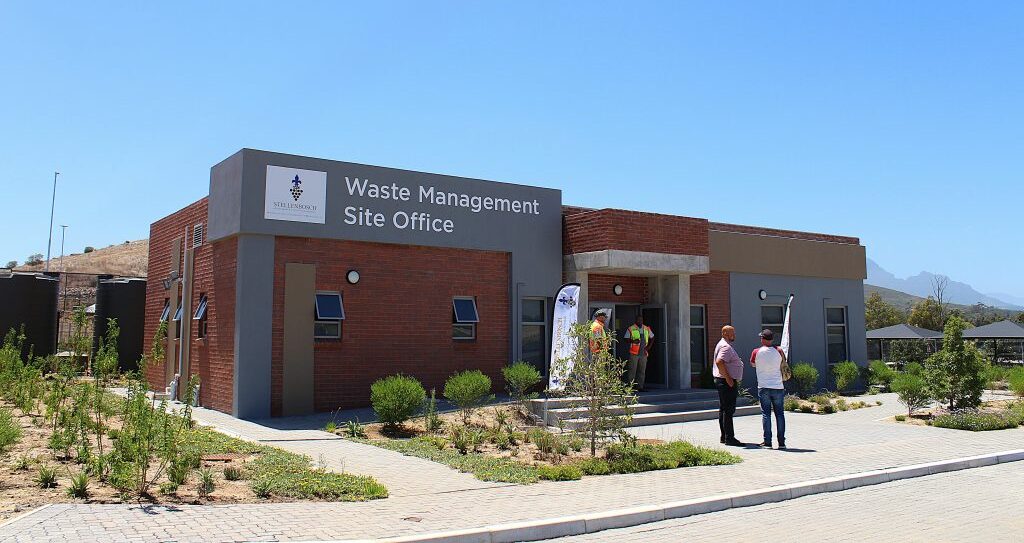
Photo credit: Stellenbosch Municipality
On a more personal level, addressing food waste is something that we all can have greater control over within our households. A Cape Town based organisation, Refreshi, recognised the problem of surplus food waste at restaurants, shops and small businesses: “±45% of all food produced in South Africa never gets eaten. 20 million people go to bed hungry each night. That mismatch is not inevitable — it’s fixable. Every bag rescued is one less meal in a landfill, one more family fed, and one more business thriving.” The solution? They created South Africa’s first food rescue app in 2025, starting with Stellenbosch-based businesses. Today they connect surplus food from local restaurants, bakeries, supermarkets and cafés with everyday South Africans at up to 50% off, across Gauteng, Western Cape, Eastern Cape and KwaZulu-Natal. Learn more here https://refreshi.co.za/
All those unused electric cords and chargers, old cell phones and computers have great value so remember E-Waste is not just rubbish, and you can discard of electronic materials responsibly: https://www.sustainabilityinstitute.net/2025/01/29/e-waste-its-not-just-rubbish/

Waste is a story we are all a part of. Does it end in landfill, or the sea, or in a new beginning for a new product or purpose?
You don’t need to wait for a system-wide fix to start. Separate your recyclables so waste reclaimers aren’t forced to sort through mixed rubbish. Support the organisations already doing this work. Ask harder questions about what you buy and how it’s packaged. Every one of these choices is small, but they’re also the only way any circular system actually gets built, one household, one habit, one choice at a time.
In the end, “away” was never really a place. It’s just wherever we’ve stopped paying attention.
Sources:
- https://wasteaid.org/programmes/current-programmes/south-africa/
- https://explain.co.za/2026/06/08/they-keep-mzansi-clean-the-system-leaves-them-exposed/
- https://www.oecd.org/en/publications/global-plastics-outlook_de747aef-en.html
- https://stellenbosch.gov.za/2021/03/25/stellenbosch-launches-new-waste-material-recovery-facility/