


“Rather than seeing our relationships as hierarchical and competitive, can soil horizons inform us about how to build relationships horizontally and cooperatively?” huu nguyen, from Soil Loss is Soul Loss
Twenty five years ago, two South African visionaries imagined creating a socially just and transformative space that nurtured nature and people. It was intended to be a living example of what a community could be, and act as inspiration for others to imagine what they could create or be a part of themselves.
Today, as we recognise World Environment Day, we stand in the realisation of this dream. Each aspect of the grounds, garden and homes in the Eco-Village at the Sustainability Institute tells the story of transformation and of creating a space like no other, anywhere else in the world. We call this place our Imaginarium. Each building here has a story, the garden speaks for itself and the children, staff and tenants who spend their days here are all part of the Imaginarium that is the Sustainability Institute.
Like the underground network of fungal threads that make up mycelium we believe in creating invisible bridges that share knowledge and resources across communities. Mycelium offers a powerful metaphor for how a connected network, a community, can look after an entire ecosystem. The mycelial network in a single teaspoon of soil can stretch over 8 kilometers long, connecting trees and plants in a “wood wide web” that shares nutrients and even warning signals. Every handful of healthy soil contains more living organisms than there are people on earth. Think about that.
Once upon a time we thought about soul, soil and society and how they connected. Based on this interconnectivity we began our journey of restoring our small part of the Lynedoch Valley.

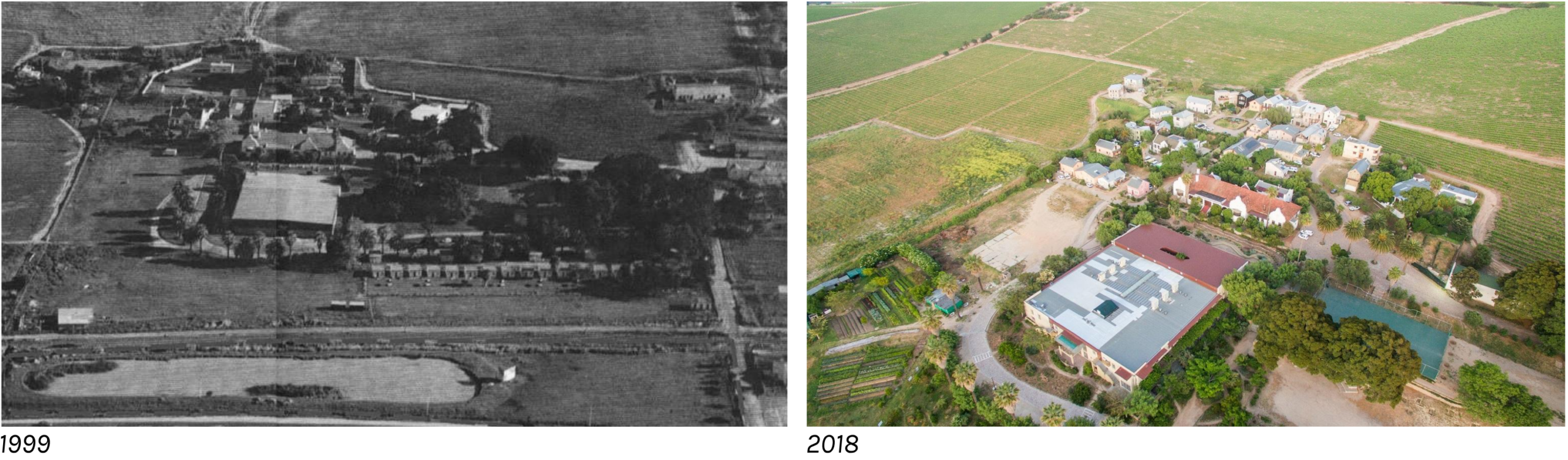
These images show how biodiversity has increased over the years. Many birds, reptiles and other living animals have made our grounds their home.
Restoring the Soil
Biologically alive soils generate the kinds of plants that are resistant to diseases and it is a key goal of our gardening team to make sure our food garden’s soil is healthy so that the plants will look after themselves. By prioritising the soil, we have created a foundation where nature can truly thrive.
Throughout the years our team of grounds staff, permaculture gardeners, students and pupils have all contributed to transforming and restoring the soil to health through process and focused attention. Mountains of natural compost dug into the soil over the years, has resulted in our campus becoming a living laboratory of biodiversity.

Transformation of the food garden over the years, where we follow a permaculture approach.
Learning Food Garden and Woodland
Our food garden is also used as an integrated learning space for children across our learning programmes, as well as adults that attend short courses, workshops or as tertiary institution students. This is part of our broader approach to learning where we create a mix of experiences across a diversity of social worlds that are rarely connected together in a single space.
Here, students and visitors connect with the soil and witness biodiversity in action. When they put their hands in the soil, they are part of our present story that reflects imagination, hope, agency, joy, creativity and interconnectedness.
The SI Nursery also grows a variety of seasonal vegetable seedlings, such as cabbages, kale, broccoli, carrots, sweet basil, and thyme, which are used in the food garden, sold to other growers and donated to school gardens in the Lynedoch Valley.
Beyond the rows of vegetables, lies one of the biggest transformations at the SI. The Woodland offers a cherished sanctuary for contemplation, amidst hundreds of trees and shrubs. These trees – planted by hundreds of hands over the years – have grown tall alongside the community, fostering a deep reconnection and reverence for the “more than human” world. The diversity of indigenous plants documented in our woodlands is a showcase of a landscape reclaimed. Last year we planted another 100 trees.

Transformation of the woodland over the years.
We have seen how a community heals and the children who attend our schools get to delight in a garden that they can see feeds them and they love to play in. Could the health of the soil and the health of a community be the same story just told in different ways?
Indigenous plants
During 2017 indigenous edible plants were added to the food garden and now feature in some meals available from our Green Café. These include spekboom, veldkool, sandkool, sout slaai, dune spinach and African boxthorn (aka ‘slangebessie’, which many believe is the African version of the superfood goji berry).
Indigenous edibles are also part of the Nourish team’s menu for the feeding programme and our children love the flavours and diversity of the food we make for them.
The local indigenous edible plants of the Greater Cape Floristic Region offer a promising path toward sustainable food security; some contain up to five times more vitamins and minerals than introduced species while requiring fewer inputs and demonstrating greater climate resilience.
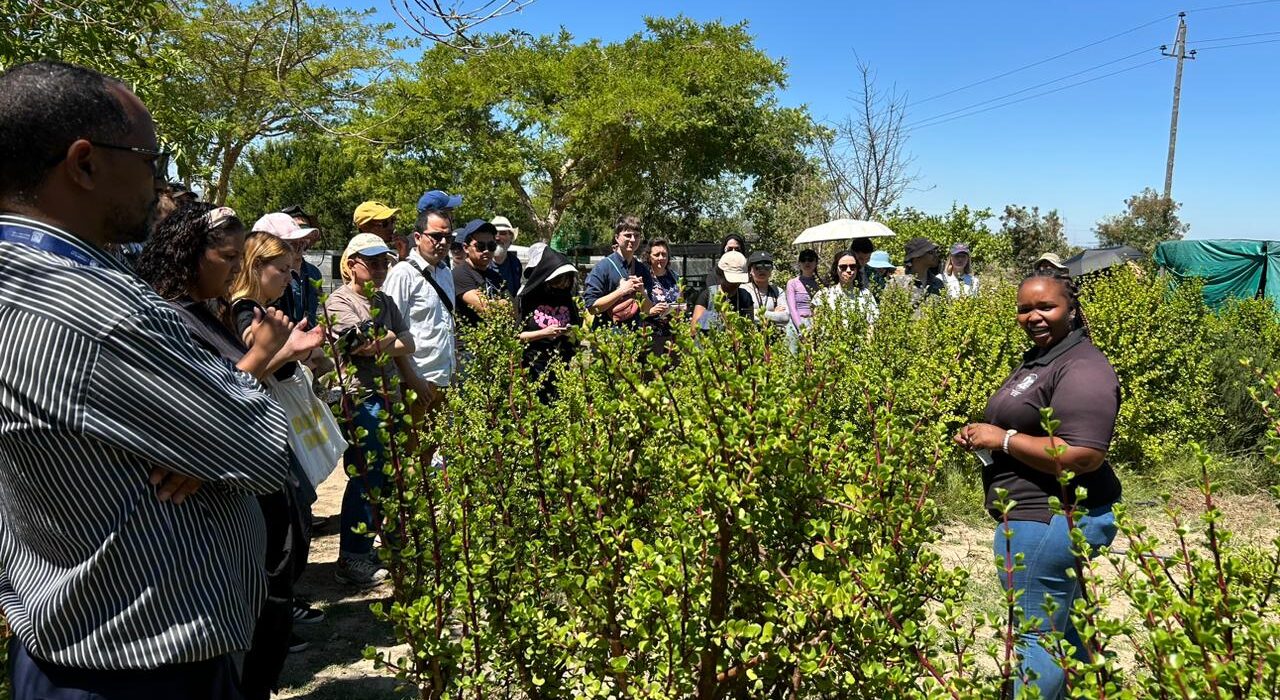
Visitors learning more about the indigenous edibles planted in our food garden.
Relationships: Nature as teacher
At the SI, our spaces are intentionally designed to connect people to nature and the pedagogies we work with integrate mind, body, and spirit.
At the Lynedoch Children’s House, we make nature a meaningful part of our learner’s everyday experience at school. Through weekly garden lessons, learners take responsibility for different parts of the garden, where they learn to plant, care for and harvest vegetables and then also learn to prepare and make food using the vegetables.
For the Lynedoch Community School learners in the 6-9 environment Nature is a huge part of their everyday learning. This relationship ignites curiosity within the children, sparks questions and leads to doing further research. We currently have a group researching flowers, looking at the parts and function of the flower as well as the various shapes. The children notice and are intrigued by the natural world around them, it drives their intellectual curiosity and inspires them to seek out the wonderful natural spaces we have on our doorstep.
We also make regular use of our outdoor classroom for certain lessons, giving learners the opportunity to learn in a calm, and natural environment. These experiences encourage responsibility, team work, curiosity and a stronger connection to the world around them, while also supporting their overall wellbeing.
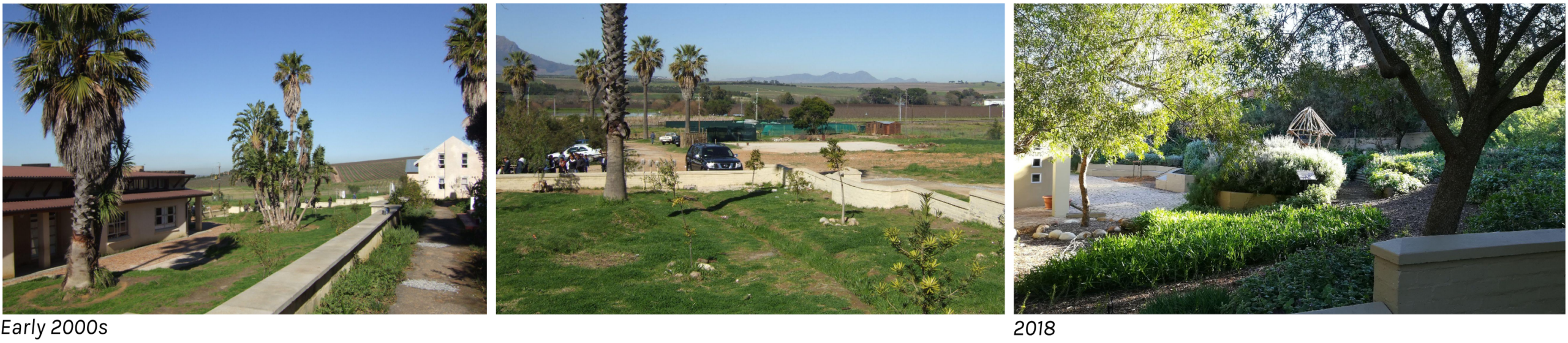
Transformation of the Knowledge Garden outside the school area, over the years.
The Youth Hub uses nature as a functional teacher, and the healing that results from interaction is something to behold. Anelisa Kamo, Youth Hub facilitator, witnessed such transformation during a recent youth camp at Ihlathi Bush Camp in Atlantis on the West Coast.
Their focus was to offer activities that amplified sensory awareness in a beautiful natural setting. One technique involved limiting one sense to become more aware of another. For example, closing one’s eyes to listen more intently. Twenty six of our youth discovered a new inner awareness, and experienced their senses in a new way. To be in nature offers a different ‘escape’, one that actually connects them to themselves.
These immersive experiences ensure that the next generation is not just learning about the environment but learning from it, developing a sense of responsibility for the earth.
Our reach extends into the broader Stellenbosch community as well. For example, we host members of the ChangeAbility group. In the food garden they learn about growing and harvesting their own vegetables, medicinal plants sowing and planting and how to make cuttings. Showing people how to care for the land and grow their own food builds independence and creates stewards for the land.

Entry road into the Sustainability Institute.
Soil is not dirt. It is the accumulated wisdom of ten thousand years of life, death, and return and we are losing it faster than any generation before us. Nature shows us the processes that demonstrate the cycles of regeneration. Mycelium has always known how to share resources across boundaries. Lichen has always known that symbiosis outlasts competition. Trees grow by giving, not by taking.
We viewed the restoration of our soils like the restoration of a relationship – important and necessary to thrive. And just like healthy soil feeds plants, imagination is your soul’s soil: tend it well, nourish it, nurture it, plant good ideas, good thoughts and good intentions and who knows what next year’s day of recognition could reveal.