


The Sustainability Institute welcomed “Slow Disasters”, an intercontinental project exploring what the artist responsible for its creation, Andrew Merritt, hopes to see result in Field Hospitals and Field Kitchens.
This exploration of the gradual unravelling of landscapes and their bio-culture due to colonisation and development was explored through the most intimate and unifying of lenses: food.
Four maps lay before us, each a portal to a different era of the Lynedoch Valley’s history. The maps were graphic reminders of the biodiversity that once thrived in the region and indicators of change over hundreds of years. In this context however they became invitations to taste, to remember, to grieve, and ultimately, to reimagine the landscape of then, now and into the future.
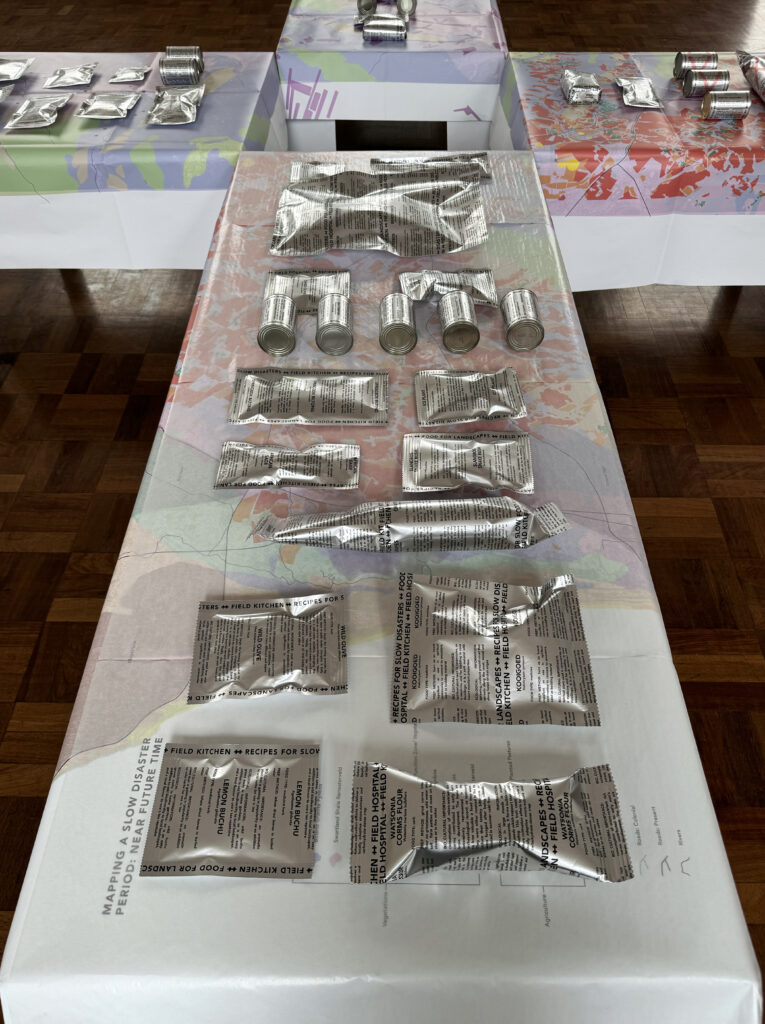
As we sampled foods from each historical period, we consumed more than nourishment, we tasted stories of transformation, loss, and the persistent possibility of regeneration.
This is the work of edge-walkers who stand at the threshold between what was and what might be, to hold both the weight of a slow ecological and social disaster and the lightness of emergent hope.
When the Cape colony began it was because the ships needed fresh fruit and vegetables to nourish the sailors on the long spice route. History now shows us that this precipitated the slow disaster of cultural erasure and agricultural dominance of foods that are not natural to the Greater Cape Floristic region.
In evidence today are large swathes of land given over to monoculture (think grapes and wheat) yet are considered signs of beauty, progress and food security. Slow Disasters provokes questions into our relationship with the land both historically and in the future. How do we treasure bio-culture and biodiversity and what crops will be resilient to withstand a varying and changing climate? And what recipes can we create from crops that provide nourishment and sustenance for the growing population?
In response to these questions we invoke our imagination and engage with communities of thinkers to explore the future of food. We ask what food the landscape needs as much as what we grow to feed an ever increasing population that are intensely economically marginalised.
Andrew Merritt is the artist who began this questioning experience a few years ago during a Politics of Food residency at Delfina Foundation. It was at Delfina that Andrew first developed the term Slow Disasters.
His other sites for the project include the Fenlands in the UK and Oaxaca in Mexico, and he mentions that out of the disaster zones of Chernobyl and an abandoned airport project elsewhere in Mexico interesting culinary regeneration has occurred.
In immediate disasters there are field hospitals and field kitchens set up. Out of this standard response scenario Andrew wishes to create Field Kitchens with a difference, one’s that create recipes for healing landscapes The Field Hospitals will be the places where these recipes are grown and the landscape nursed back to health through plants and crops that can be future resilient and feed both the soil and people.
Slow Disasters was brought to life at the SI because of the collaboration between Merritt and the SI’s Loubie Rusch and exemplifies the mycelial nature of the SI’s Knowing Collective.

It is an example of how connecting art, ecology, archaeology, and community across three continents, can present and explore knowledge systems that refuse singular categorisation.
The questions posed were deceptively simple yet profound: What food does the landscape need? Where is there appetite for experimentation to regenerate lost relationships? These are agricultural questions and fundamentally relational ones, recognising that landscapes hunger, that ecosystems also grieve broken bonds, that healing requires both imagination and action.
As the diverse group of people from the Lynedoch valley and the SI, and those from the public discussion held during Cape Town’s Design Week marked the maps with their recipes of memory and traditions, and their hopes for the future interventions, something deeper emerged.

We were not just documenting potential pathways to ecological restoration; we were enacting the very philosophy that animates the SI’s Knowing Collective. We were system-shifting in real time, moving from passive observers of environmental and social decline to active weavers of possible futures.
We were life-affirming, asserting that even slow disasters can be met with creative resilience and hope. And we were deeply relational, understanding that the healing of landscapes cannot be separated from the healing of communities.
About Andrew Merritt: Andrew’s biography:
Andrew Merritt is one half of the artist duo Something & Son, his work explores social and environmental issues via everyday scenarios criss-crossing the boundaries between the visual arts, architecture and activism. Through permanent installations, functional sculptures and public performance that provide a framework or foundation for communities and ecologies to build upon. Works mimic the everyday to act as a familiar starting point and then take the subject into new realms. The collective responses were logged on the maps and shared at the Nature and Circularity Conference, and on display to the public at Design Week Cape Town.